

Data and knowledge: the foundation of energy transitions
“Em Perspectiva” is ALER’s new opinion and analysis series, where the latest developments, trends, and debates shaping the energy sector in Portuguese-speaking countries are examined.
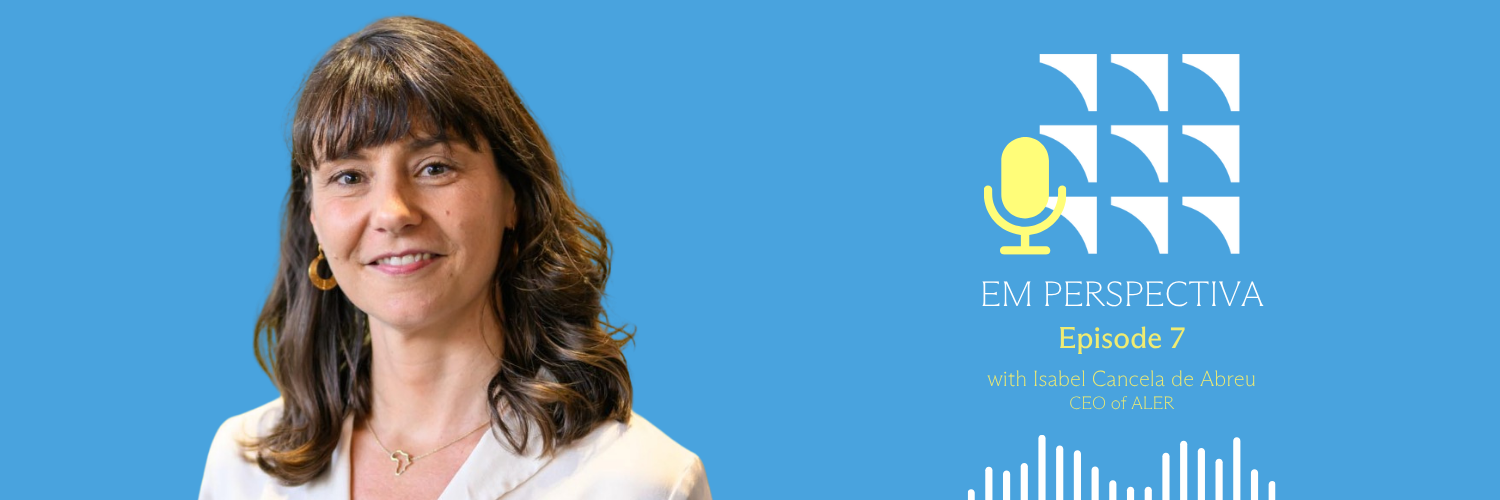
In this edition, Isabel Cancela de Abreu, CEO of ALER, reflects on the role of data and knowledge in accelerating energy transitions across Portuguese-speaking countries.
We discuss the importance of information systems in supporting planning, attracting investment and monitoring the implementation of public policies. We highlight recent examples from Mozambique, Guinea-Bissau, Angola, Cabo Verde, Timor-Leste, São Tomé and Príncipe, Portugal and Brazil, and analyse how reports, energy balances and monitoring platforms help turn targets into concrete results.
The conversation that inspired this article is also available as a podcast on Spotify.
Isabel, this month’s podcast focuses on a slightly different topic. Why talk about data and knowledge?
The idea for this episode was inspired not only by Rodrigo Sauaia’s editorial for ABSOLAR and the remarkable growth figures of Brazil’s solar market, as well as the data recently published in Mozambique and Guinea-Bissau, but also by the report presented at the Global Renewables Summit during Climate Week NYC, which tracks global progress towards the 2030 renewable energy targets. It also follows the Tracking SDG 7 report, which was featured in our newsletter a few months ago and monitors global progress towards Sustainable Development Goal 7 on energy access.
Rather than simply listing and analysing the figures presented in these reports, we felt it would be valuable to discuss the importance of data and knowledge for energy transitions.
Without data, we cannot measure progress, define priorities, plan effectively or monitor implementation. Ultimately, data helps us understand where we are succeeding and where further action is still needed.
Data also creates a sense of urgency, a real call to action, by giving a concrete dimension to reality. It quantifies challenges, helps us understand how far we still have to go to achieve the goals we have set, and supports the mobilisation of the partners and resources needed to reach them.
And when you talk about tracking and measuring energy transitions, how do data fit into that process?
They sit right at the foundation. At ALER, we often represent this process through what we call the “energy transitions ladder”.
And I should stress that, at ALER, we always make this distinction and speak about energy transitions, in the plural, because there is no single energy transition. Every country has its own reality, resources and challenges and, therefore, its own pathway.
The first step is precisely understanding our reality. This is where data and knowledge come in: they help us understand where we are and identify our starting point.
From there, we move on to policies, legislation and planning. Once we know where we are and where we want to go, we can define what needs to be done to get there, in a way that is tailored to the reality of each country or region.
Next come projects, because policies and plans need to be translated into concrete initiatives and implemented on the ground.
To make this happen, we also need leadership and capacity-building, people and institutions capable of turning policies into projects, mobilising partners and creating the conditions necessary for those projects to move forward.
And then we reach the top of the ladder: financing and investment, because without the necessary financial resources it is impossible to implement projects.
In practice, there are two very clear flows at work here. First, there is an upward flow of information: data sit at the base and feed every stage of the ladder. They are also fundamental for financiers and investors, because without reliable information about markets and projects it becomes much harder to make investment decisions.
There is also a downward flow of financing and investment. Without investment, projects cannot be implemented; without projects, there are no new results; and without results, there is no updated data.
That is why data are so important: they underpin the entire process and enable countries to climb the energy transitions ladder.
And looking at ALER’s own history, this first step – knowledge – has always been central. What contribution has ALER made in this area?
In fact, producing and disseminating market information is part of ALER’s DNA. It was one of the first areas we started working on and remains one of the activities that has contributed most to the association’s visibility.
Today, we have three strategic pillars, and the first is precisely “More than informing, understanding”.
Because we believe that information only creates real value when it helps us understand markets and supports better decision-making.
We do this primarily through our reports and publications. The first major product for which ALER became known was the Renewable Energy Status Report in Mozambique, first published in 2016. We later developed similar publications for São Tomé and Príncipe, Guinea-Bissau and Angola.
Over time, we evolved towards shorter and more strategic products. One example is the Mozambique Renewables Brief, now in its fifth edition and recently presented at RENMOZ. Today, it is a reference publication for the sector and an important tool for tracking the country’s energy transition.
However, our reports go beyond statistics. We combine data with information about the sector itself: who the main stakeholders are, how the market is structured, and what policies and regulatory frameworks are in place.
More recently, we have added a new dimension to this work through the identification of project pipelines. This was one of the innovations presented at RENMOZ and is an approach we intend to develop in other countries as well.
In other words, we are climbing our own ladder: the information we provide starts with data, moves through sector analysis, policies and planning, and now reaches the project level as well.
We also operate the LER Renováveis platform, which serves as a Portuguese-language documentation hub, bringing together relevant national and international information on renewable energy and energy transitions. It is a free resource that deserves to be better known.
Ultimately, our goal is to make information more accessible. Data often exist, but they are dispersed across different institutions, reports and platforms. We work to consolidate that information, cross-check sources, process the data and present it in a way that is easier to access and interpret.
And we always do this in partnership with national associations, because they are the organisations closest to the realities of their respective markets.
So, it is not just about having more data, but about turning that data into useful knowledge. We have recently seen some encouraging developments across Portuguese-speaking countries. What examples would you highlight?
Yes, and I think this is a very positive development.
In some countries, such as Portugal and Brazil, there is already a long tradition of producing and publishing energy statistics.
In Portugal, for example, we have publications such as Renewables Fast Statistics and the annual report Energy in Numbers. In Brazil, alongside publications produced by government institutions and technology-specific industry associations, the Brazilian Energy Transition Atlas was published in August.
However, we are also seeing encouraging progress in countries where, until recently, much less information was available.
In Mozambique, for example, in addition to our Mozambique Renewables Brief, produced in partnership with AMER, we are witnessing more regular information being published by national institutions, namely ARENE through its quarterly bulletins and MIREME through its Statistical Energy Report and, more recently, the Energy Transition Strategy Radar (Radar ETE).
In Timor-Leste, the country’s first National Energy Balance is currently being developed with the support of the ASEAN Centre for Energy.
I would also like to highlight the case of Guinea-Bissau, where the 2025 National Energy Balance was validated in September through the National Energy Information System Cell. This represents an important milestone, as no National Energy Balance had been published for several years.
More than simply being a statistical publication, the balance provides a much clearer picture of the country’s energy reality and, in some cases, new data even require us to revisit assumptions we previously considered accurate.
For instance, we often referred to an electricity access rate of around 35%. The new balance shows that the real figure is lower, at around 31%, and that access remains concentrated in urban areas, while in rural areas it is still virtually non-existent. This changes our understanding of the challenge and allows strategies, plans and projects to be better aligned with the country’s actual situation.
These are initiatives that deserve recognition, because regularly produced information from national institutions is essential for supporting public policy decisions and providing greater predictability to markets.
Considering that we were just talking about SDG 7, which sets the goal of universal access to energy by 2030 – and 2030 is now right around the corner – what do we need to do to ensure that these data actually translate into achieving those targets? How can data help us continue climbing the energy transitions ladder?
I would highlight four key priorities to ensure that data have a truly transformative impact on energy transitions.
The first is collaboration. It is very difficult for a single institution to have access to all the necessary data. Even ministries or national energy directorates, which are often responsible for compiling and publishing data, need to work closely with utilities, national energy and electrification funds, regulators, the private sector, development partners, national associations and national statistics institutes. Only through this collaboration can we ensure that data are complete and up to date.
The second is harmonisation: common methodologies and standards that ensure data quality and make it possible to compare information over time.
The third is consistency. It is not enough to produce data once. Information needs to be generated and published on a regular basis so that we can monitor trends, provide predictability to the market and adapt policies and projects to changing realities.
And finally, there is dissemination. It is not enough to have reports stored away in drawers or published on websites that very few people visit, nor is it sufficient to make large volumes of raw data available without any processing or interpretation.
Stakeholders need access to information that is clear, understandable and engaging, so that it can effectively be used in planning and investment decisions.
This is also where ALER seeks to contribute. In our Briefs, we pay close attention not only to the selection and analysis of data, but also to the way information is presented. Through our events, we seek to highlight key trends, challenges and achievements revealed by the data.
Because the goal is not to produce statistics for the sake of producing statistics.
The goal is to ensure that information is available to support better planning, better investment and better implementation. The idea is simple: to transform data into decisions, decisions into projects and projects into results, and to continue climbing the energy transitions ladder towards the targets we have set.