

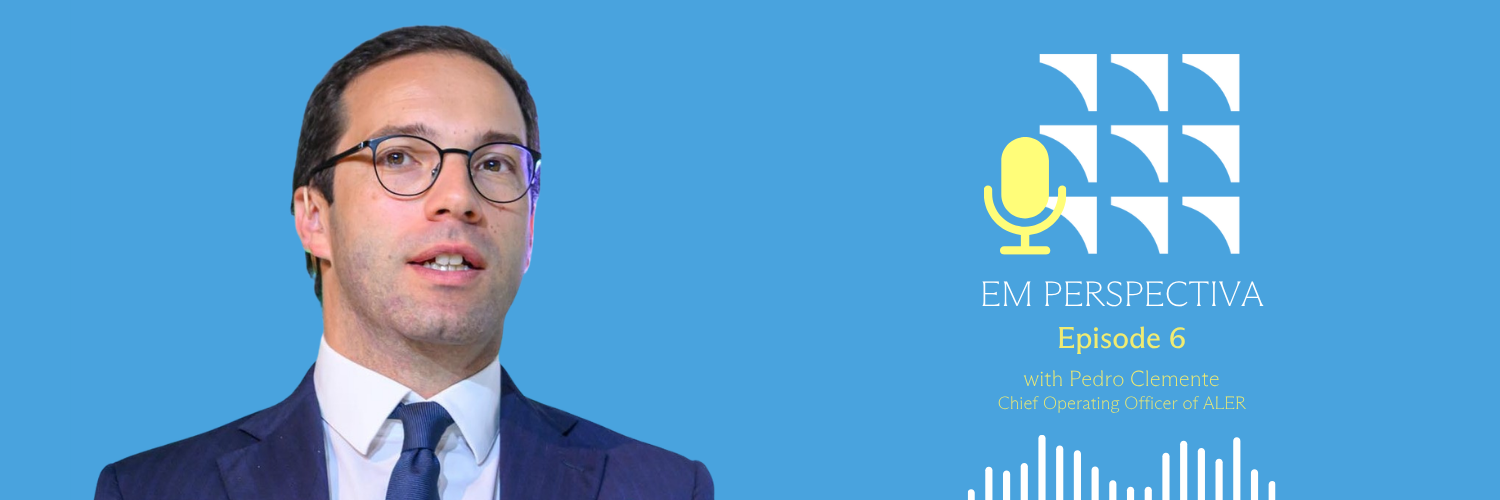
Electrifying for development: a priority of the energy transition
“Em Perspectiva” is ALER’s new opinion and analysis series, where the latest developments, trends, and debates shaping the energy sector in Portuguese-speaking countries are examined.
In this edition, Pedro Clemente (Chief Operating Officer of ALER) reflects on how electrification is playing an increasingly strategic role in the economic development of Portuguese-speaking countries.
We discuss the global Electrify Now movement, the growth of renewable energy, the expansion of transmission networks and how countries such as Angola and Mozambique are using energy to strengthen regional integration, attract investment and drive industrialisation. More than a question of access to electricity, energy is becoming a tool for competitiveness, job creation and economic transformation.
The conversation that inspired this article is also available as a podcast on Spotify.
Pedro, this month’s discussion starts with the launch of the global Electrify Now movement. What exactly is this initiative and why is it mobilising so many international organisations?
It is a global movement that brings together governments, businesses and civil society around a single objective: accelerating the pace of electrification.
Today, electricity accounts for around 21% of final energy consumption worldwide, and the goal is to reach 35% by 2035, a target that was also endorsed by the COP31 Presidency. This would require more than quadrupling the current pace of electrification.
What makes this initiative particularly interesting is the alignment of voices behind it. The International Energy Agency, the United Nations, IRENA and business coalitions representing trillions of dollars in revenues are all promoting the same idea: electrification is no longer just an environmental issue, it is also about economic competitiveness, energy security and development.
For many years, electrification was seen mainly as a way to reduce emissions or increase access to energy. Today, it is increasingly viewed as a lever to improve productivity, support industrialisation, attract investment and create jobs. In other words, energy is taking on an increasingly important role as a driver of economic development.
You mentioned the 35% target by 2035. How are Portuguese-speaking countries performing in renewables?
The latest IRENA reports provide very encouraging figures. For the first time, global installed renewable capacity has surpassed coal, while costs continue to fall: solar power now averages USD 44/MWh and wind power USD 33/MWh.
This trend is also visible across Portuguese-speaking countries: Brazil increased its renewable capacity by 6.7%, Portugal by 5.6%, Cabo Verde by almost 26%, and São Tomé and Príncipe by 25%. Solar energy remains the main growth driver.
Perhaps ALER’s key takeaway from these figures is that the challenge is no longer simply about installing more renewable capacity. The real challenge is using that energy to create economic value. We are seeing the debate evolve from energy generation to the economic impact of energy.
IRENA says that costs are becoming increasingly competitive, but that the main barriers are no longer technological. Is that what you see on the ground?
Exactly. The potential and competitiveness of renewable energy are already well proven across Portuguese-speaking countries. However, accelerating deployment requires the ability to structure bankable projects that can mobilise financing and build confidence among private investors.
A good example was RENMOZ in Europe, in Brussels, where ALER supported Mozambique in presenting its strategic energy pipeline directly to European investors. This type of connection between projects and capital often makes the difference between potential and tangible results.
Is producing more renewable energy enough, or is more needed?
Generation is essential, particularly given the expected increase in future demand, but it is not enough to deliver transformation. Clean energy must reach people and businesses.
That is why transmission and distribution networks are receiving increased attention. Without networks there is no access, no integration of renewables and no development.
What examples of this focus on transmission have we seen this month?
We have three very clear examples.
In Angola, the Government awarded a 30-year concession for the Northern Corridor, an 800 MW high-voltage transmission line that will connect Soyo to the border with the Democratic Republic of Congo. This will extend the transmission network to Cabinda Province and position Angola as a strategic energy supplier within both the Southern African Power Pool (SAPP) and the Central African Power Pool (PEAC).
In Guinea-Bissau, electricity finally reached Bafatá and Gabú through the OMVG regional project after decades without access.
And in Timor-Leste, the new Comoro Substation was inaugurated in Dili, alongside a new transmission network and a pilot underground cable project.
At first glance these may seem like purely technical infrastructure investments, but they represent much more. They are essential to achieving universal access and unlocking the potential of energy as a driver of prosperity.
You mentioned the Northern Corridor in Angola as an export-oriented transmission line. So this is not only about domestic infrastructure, but also about exports?
Exactly, and that is perhaps the most interesting aspect. Angola is not only strengthening its domestic electricity system. It is positioning itself as a regional exporter, supplying electricity to the Democratic Republic of Congo through this interconnection.
Mozambique is following a similar path, and in an even more deliberate way. Just a few days ago, President Daniel Chapo presented Mozambique as a future regional energy hub, supported by the expansion of the Cahora Bassa Hydropower Plant to help address an energy deficit of around 10,000 MW across Southern Africa.
This is particularly significant because it shows energy taking on a new economic function. Energy is becoming an economic asset capable of generating revenue for countries while strengthening their strategic regional position.
Are there also countries benefiting in the opposite way, by being connected to these regional electricity networks?
Yes, and Guinea-Bissau is a good example. The rapid electrification of Gabú is only possible because the country is connected to the regional OMVG project, which supplies hydropower generated in Guinea and shared among several countries in the region.
Regional integration works both ways. Not every country will become an exporter like Angola or Mozambique, but being connected to a regional network also delivers direct benefits to importing countries.
We speak a lot about access and exports, but Mozambique’s President, Daniel Chapo, insisted that energy should not only be used for exports. What role does electrification play in job creation and industrialisation?
This is a central issue. Energy security is strategic for a country’s development. It helps strengthen the domestic economy, support industrialisation, create jobs and improve the competitiveness of national businesses.
This links directly to what we see in the Electrify Now movement. Companies and institutions supporting the initiative argue that electrification improves competitiveness, reduces risk and creates better conditions for economic growth.
This combination of cheaper, more reliable energy available to productive sectors is what enables us to talk about green industrialisation.
And this is one of the key messages ALER has consistently highlighted: the success of the energy transition will not be measured only by installed megawatts or electrification rates. It will be measured by its ability to create jobs, improve business competitiveness and generate greater socio-economic value.
Does digitalisation also play a role in this process?
Absolutely. It was one of the themes highlighted at EurAfrican Forum 2026 in Cascais, where ALER was present. During the discussion between the Presidents of Portugal and Mozambique, it became clear that long-term Europe-Africa partnerships will increasingly focus on digital transformation, technology and youth skills development.
Without reliable electricity, there is no digitalization, no industrial automation and no digital competitiveness.
It sounds as though we are talking about a new phase of the energy transition.
Without a doubt. We are moving away from a model focused solely on access towards one where energy is an economic asset, a tool for exports and regional integration, and also a driver of employment, green industrialisation, digitalisation and competitiveness.
Perhaps that is the key message of this episode: the success of the energy transition will no longer be measured only by the amount of energy produced, but by the ability to transform that energy into opportunities for people, businesses and countries.