

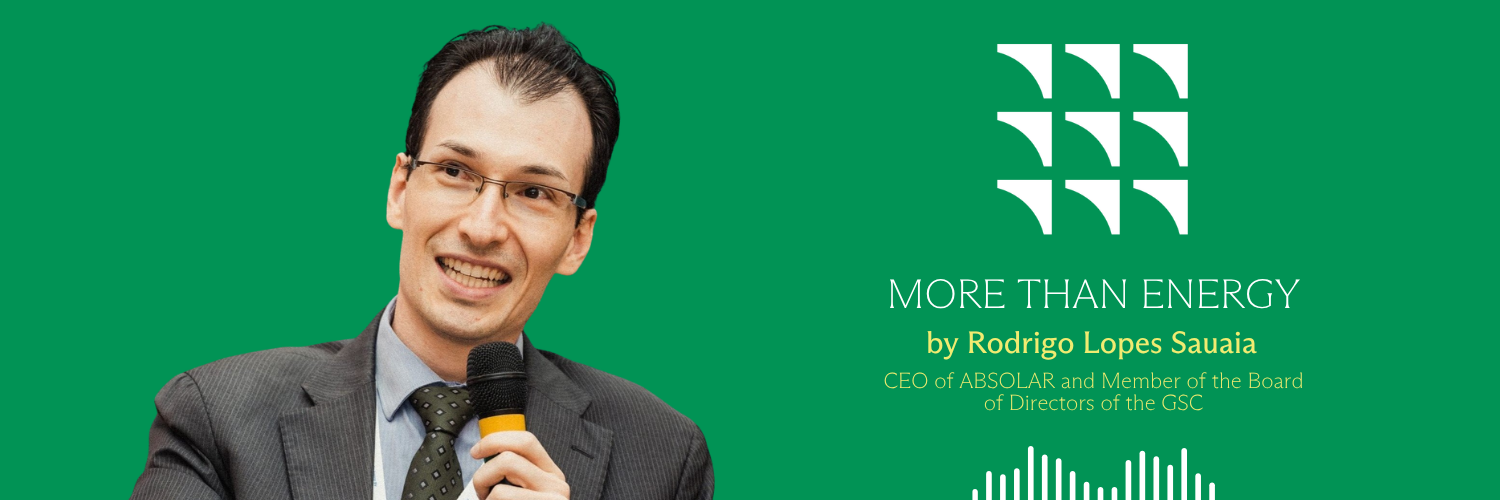
From solar expansion to flexibility: the new chapter of the energy transition
Solar photovoltaic energy has entered a new phase of its journey. Globally, solar power has just surpassed the historic milestone of 3 terawatts (TW) of installed operating capacity, consolidating its position as the leading driver of renewable energy expansion worldwide. In 2025, photovoltaic technology accounted for 77% of all renewable capacity added globally and generated 2,778 terawatt-hours (TWh) of electricity, representing approximately 9% of global electricity demand, according to data from the International Renewable Energy Agency (IRENA).
These figures demonstrate the scale of this transformation, but they also point to a new challenge: sustaining solar expansion requires adequate electricity infrastructure, market rules aligned with business model realities, and technologies capable of supporting an increasingly large share of variable renewable energy sources in national power systems.
This ongoing transformation also highlights the importance of cooperation and partnerships among sector associations from different markets. In this regard, the Brazilian Association of Solar Photovoltaic Energy (ABSOLAR) and ALER have been working collaboratively to promote the development of solar energy. In addition, both organizations have advocated for the integration of electricity storage solutions within their areas of activity, sharing experiences, technical knowledge, and development agendas to accelerate the energy transition.
This collaboration gains even greater relevance through the Global Solar Council (GSC), an organization that brings together national and regional solar and energy storage associations, of which both ABSOLAR and ALER are active members.
Brazil, in turn, plays a strategic role in this context. Solar power is already the country's second-largest source of electricity generation capacity, accounting for 28% of Brazil’s installed power capacity. Since 2012, the sector has attracted more than BRL 328.2 billion in new investments, created over 2.2 million local green jobs, and avoided the emission of 127.5 million tonnes of CO₂ from electricity generation.
More recently, however, the Brazilian solar market has experienced a slowdown. In 2025, 14.5 GWp of solar capacity was added, compared with 18.9 GWp in 2024, representing a 23% decline. This trend does not diminish the strategic importance of solar energy. On the contrary, it indicates that the next growth cycle will increasingly depend on the ability of Brazil’s power sector to adapt to a new reality in which renewable generation occupies a much larger share of the energy mix. It is precisely at this point that energy storage emerges as a strategic ally of solar power.
Brazil is beginning to lay the foundations for this new market. The first two Capacity Reserve Auctions for Energy Storage (LRCAP Storage), scheduled for 2 and 4 December 2026, received applications from more than 6,000 projects, representing an impressive 296.9 GW of battery energy storage capacity.
This volume demonstrates both investor interest in the Brazilian initiative and the maturity reached by storage technologies. ABSOLAR has played a strategic role in building these foundations, advocating for the auctions and contributing to the improvement of the rules and contracting conditions established by the Brazilian government.
The regulatory framework for this market is also advancing on several fronts. Public Consultations No. 022 and 023/2026, launched by the National Electric Energy Agency (ANEEL), discussed draft regulations for the first procurement processes involving battery energy storage systems, which will include 15-year contracts with power supply scheduled to begin in August 2028.
Meanwhile, Public Consultation No. 032/2026 addresses the first transmission auction involving battery storage in Brazil’s National Interconnected System (SIN), scheduled for April 2027. This development shows that storage is increasingly being incorporated not only as a generation-related resource, but also as critical infrastructure to enhance system reliability and flexibility.
This agenda is far from an isolated initiative and is expected to continue in the coming years. Recently, Brazil’s Ministry of Mines and Energy (MME) announced the electricity sector auction schedule for the 2027–2029 period, including at least one Capacity Reserve Auction per year open to battery storage systems. As a result, Brazil will hold storage auctions in 2026, 2027, 2028 and 2029, providing greater predictability for developers, investors, and the supply chain. This continuity will be essential to positioning Brazil as a major energy storage market in the years ahead.
Brazilian regulation is also advancing on other fronts. In November 2025, Law No. 15,269/2025 formally incorporated energy storage technologies into the country’s electricity sector framework and introduced tax incentives for large-scale battery systems until 2030. In June 2026, ANEEL issued Normative Resolution No. 1,161/2026, establishing procedures for standalone storage systems and defining rules for integrating storage into power generation facilities. In September, the Agency launched Public Consultation No. 033/2026, proposing modernized connection rules to enable smarter integration of distributed solar generation, batteries, electric vehicles, and other distributed energy resources.
Regulatory modernization also extends to system operation itself. Public Consultation No. 034/2026 proposes updates to operational classification criteria for power plants within the National Interconnected System, taking into account growing operational complexity and the need for stronger coordination among market participants and the National System Operator (ONS). At the same time, Public Consultation No. 036/2026, launched in October, seeks to adapt transmission access rules to the National Transmission Access Policy (PNAST) established by Decree No. 12,772/2025. These discussions are essential to ensuring that renewable generation expands in a coordinated manner alongside the evolution of electricity infrastructure.
This modernization is urgent because the challenges associated with renewable expansion are already visible in the operation of Brazil’s power system. Distributed generation projects face connection difficulties in areas with network constraints and challenges related to reverse power flow.
There is also the challenge of renewable energy curtailment, which affects large-scale solar and wind power plants in Brazil. In this area, an important regulatory advance took place on 6 October, when ANEEL approved a new rule establishing the order in which generation curtailments occur, a topic under discussion since Public Consultation No. 045/2019. The new regulation aims to provide greater transparency and predictability while introducing criteria to progressively distribute curtailment impacts among different technologies and market participants.
However, while the regulatory framework provides greater clarity, it does not eliminate the economic challenges associated with curtailment. The sector still needs adequate mechanisms to address the financial impacts on affected projects. In parallel, the Federal Government has advanced the implementation of a compensation mechanism for eligible curtailments that occurred between September 2023 and November 2025, under the provisions of Law No. 15,269/2025, through MME Ordinance No. 140/2026.
In this context, batteries and other flexibility solutions represent a key part of the solution for the sustainable expansion of solar energy. Storing electricity during periods of abundant generation and making it available when the system needs it most helps align supply and demand, reduce operational constraints, increase energy security, and maximize the value of investments already made in generation and infrastructure.
Access to financing for battery systems is also progressing. Under the 2026/2027 Agricultural Plan (Plano Safra), financing lines such as Inovagro and Prodecoop now cover investments in energy storage systems for the first time, following contributions from ABSOLAR to the Federal Government. This measure expands opportunities for integrating renewable generation, storage and productive activities in agribusiness, one of the most significant sectors of the Brazilian economy.
Brazil therefore has a concrete opportunity: to turn the challenges of solar expansion into a broader agenda for modernizing the electricity sector. Achieving this will require a combination of new investments in electricity infrastructure and generation, energy storage, more efficient grid connection rules, flexibility mechanisms, adequate network access, competitive financing instruments, and regulation capable of providing appropriate economic signals and predictability for developers and investors.
The energy transition does not end with the installation of solar systems. The next chapter will be defined by our ability to integrate, store and use this clean and competitive electricity in increasingly intelligent, flexible and socially responsive ways.
Rodrigo Lopes Sauaia
CEO of ABSOLAR and Member of the Board of Directors of the Global Solar Council