

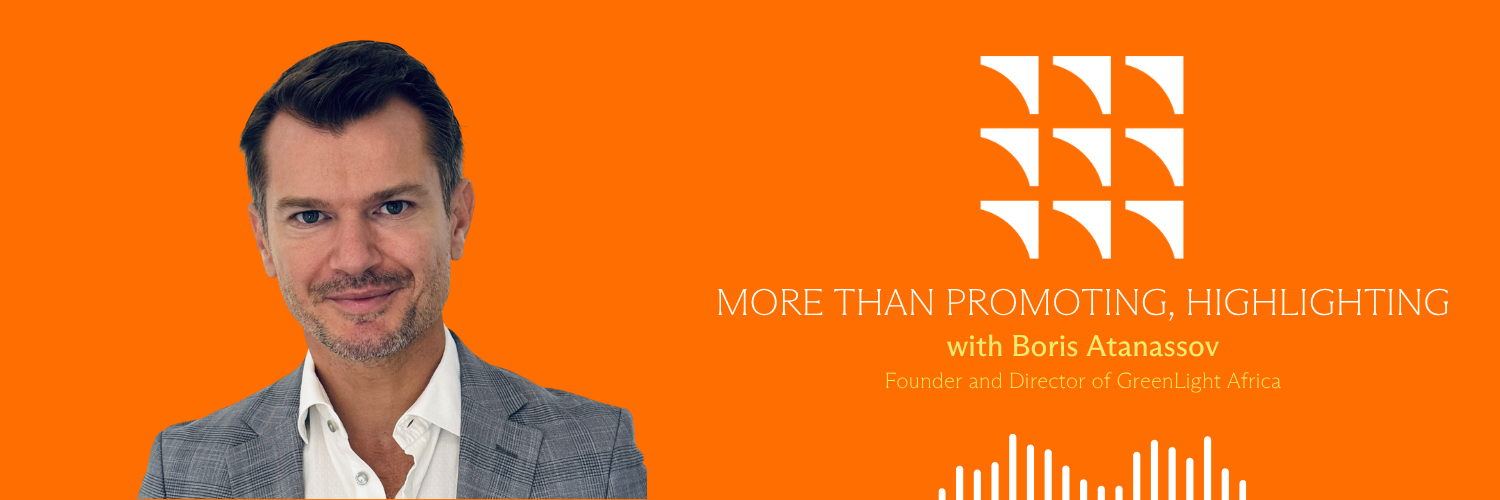
GreenLight Africa and Mozambique’s energy transition
Since 2010, GreenLight Africa has helped shape Mozambique’s renewable energy market through support for policy and regulatory development, project development, and on-the-ground implementation.
In this interview, Boris Atanassov (Founder and Director of GreenLight Africa) reflects on the company’s contribution over the past 16 years and discusses its current focus on productive uses of energy, rural entrepreneurship, sustainable transport and biofuels.
GreenLight Africa has worked in Mozambique since 2010. How has the company evolved over these 16 years?
GreenLight began at a time when Mozambique’s renewable energy market was still at an early stage. There were promising resources and strong development needs, but limited market data, few established business models and an incomplete regulatory framework. Our initial role was therefore grounded in research, feasibility studies and market development.
Over time, we evolved into an advisory, project development and investment firm that can support an initiative from its first field assessment through policy design, financial modelling, business development and implementation. We have worked with government institutions, development partners, investors and local companies, while building a multidisciplinary Mozambican team and a wider network of specialists. This combination of local knowledge and international technical standards has remained central to our work.
The most important change is that renewable energy is now treated as a core part of Mozambique’s economic development. The discussion is no longer limited to access to electricity. It includes industrial growth, agricultural productivity, clean cooking, transport, climate finance and the competitiveness of local businesses. GreenLight’s work has expanded along the same path.
Which achievements best represent GreenLight’s contribution to the renewable energy sector?
One of our reference assignments was the technical assistance provided to Mozambique’s Renewable Energy Auction Programme, PROLER. The programme created a competitive procurement framework for utility-scale independent power producers and helped establish a clearer route for private investment in solar and wind generation. GreenLight contributed local, environmental and social expertise within the wider technical assistance team.
We have also supported the off-grid market through pre-feasibility studies for 30 mini-grid sites, market assessments, tariff and tender mechanisms, and the BRILHO programme’s research and policy work. In clean cooking, our early involvement in the ethanol cooking-fuel market linked cassava production by smallholder farmers with fuel processing and urban customers. The project reached more than 40,000 stove users and sourced cassava through a network of approximately 13,000 farmers.
These assignments differ in scale, but they share a common purpose: they create the evidence, rules and delivery models needed for investment. We are equally proud of the professionals who developed their experience at GreenLight and now contribute across Mozambique’s energy sector.
GreenLight has contributed to energy regulations and national strategies. Why has this work been important?
Projects cannot scale when investors, public institutions and communities do not have clear rules. GreenLight has supported work related to the electricity law, the off-grid energy regulation, mini-grid tariffs and tenders, distributed generation, the national clean cooking strategy and the development of the biofuels sector.
The off-grid regulation approved in 2021 was particularly important because it created a clearer framework for private participation in mini-grids and other energy services outside the national network. Our role has often been to connect legal and policy work with evidence from the field: what customers can afford, what developers need to reach financial viability, and what safeguards government should maintain.
A sound regulation is only useful if it can be implemented. We therefore combine policy advice with market research, financial analysis, capacity building and practical tools for regulators and other institutions.
Why is the productive use of energy now a major focus for GreenLight?
Electricity access has greater value when it increases income and improves essential services. This is the basis of productive use of energy, or PUE. In rural areas, energy can power irrigation, milling, drying, refrigeration and other equipment that helps small enterprises produce more, reduce losses and improve product quality.
For GreenLight, the strongest opportunity lies at the intersection of energy and agriculture. Many rural communities already produce crops, fish or livestock products, but they lose value because processing, cooling, storage and transport are limited. Renewable energy can address several of these constraints at the same time. Solar irrigation can improve production, solar mills and dryers can support local processing, refrigeration can reduce spoilage, and appropriate electric-mobility solutions can help move locally produced goods to market.
The technology is only one part of the model. Equipment must be affordable, enterprises must have viable markets, and users need the skills to operate and maintain the assets. Our current work therefore combines energy technology with finance, enterprise development and market linkages.
How is the IOM pilot in Sofala applying this approach?
GreenLight is working with the International Organization for Migration on a pilot fund that introduces productive energy equipment in resettled communities in Sofala Province. The initial technologies include solar irrigation and solar refrigeration, selected because they respond to practical constraints faced by farmers and small businesses.
The equipment uses pay-as-you-go functionality to reduce the initial cost and allow users to repay over time. This is important, but finance alone is not enough. The pilot also incorporates business development training so participating enterprises can improve record keeping, pricing, equipment use, maintenance and market planning. Stronger business management should help them use the assets more productively and meet their repayment obligations.
The pilot is designed to test a complete delivery model rather than distribute equipment in isolation. We want to understand which technologies, financing terms and support services work best in these communities, and what would be required to scale the model responsibly.
What is GreenLight developing with UNICEF in Zambézia Province?
The UNICEF initiative also uses productive energy to create local enterprises, but it connects energy access directly with local food systems and child nutrition. The project supports businesses that will process locally grown crops into higher-value ingredients and nutritious porridge products for children.
GreenLight is introducing solar-powered mills and solar dryers. Milling allows local crops to be processed closer to where they are produced, while drying can improve preservation, reduce post-harvest losses and support more consistent production. The enterprises will need suitable operating models, quality controls, market planning and technical support, so our work considers the full business system around the equipment.
This project illustrates why the energy-agriculture nexus matters. A single intervention can support local farmers, create rural enterprises, retain more value within the community and contribute to the availability of locally produced nutritious foods.
How do sustainable transport and biofuels fit into GreenLight’s current strategy?
Transport is a missing link in many rural value chains. Production and processing may improve, but businesses still need an affordable way to reach buyers. We are therefore exploring e-mobility as part of the productive energy system, with solutions suited to moving locally produced goods between farms, processing points and markets. The aim is to connect renewable electricity, productive equipment and last-mile transport in one practical business model.
Biofuels are another long-standing area of work for GreenLight. Our experience began with bioethanol for clean cooking and has expanded to biodiesel and bioethanol for blending with fossil fuels. We have supported government and private-sector stakeholders with market assessments, feasibility work, feedstock development, project implementation and the planning required for a national blending programme.
We are also examining the longer-term opportunity for sustainable aviation fuel. Mozambique has agricultural resources and potential feedstocks, but development must be based on credible sustainability standards, food-security safeguards, reliable supply chains and commercially sound processing. Our role is to help translate that potential into projects and policies that investors, government and communities can support.
What will define GreenLight’s priorities in the next phase?
Our priority is to move proven ideas into implementation at a larger scale. For productive use of energy, that means developing financing structures that small businesses can manage, strengthening local suppliers and service providers, and using evidence from pilots to design programmes that can be replicated in other provinces.
We will continue to work across policy, project development and investment because Mozambique needs all three. Clear regulations create confidence, well-prepared projects attract capital, and strong local enterprises turn infrastructure into lasting economic activity. Climate finance can help close affordability gaps, but it should be linked to viable business models and measurable services for communities.
GreenLight will also deepen its work in e-mobility and biofuels while maintaining its established work in renewable power, off-grid energy and environmental services. We welcome collaboration with ALER members and other partners that can bring technology, finance and implementation experience to Mozambique and the wider Lusophone market.