

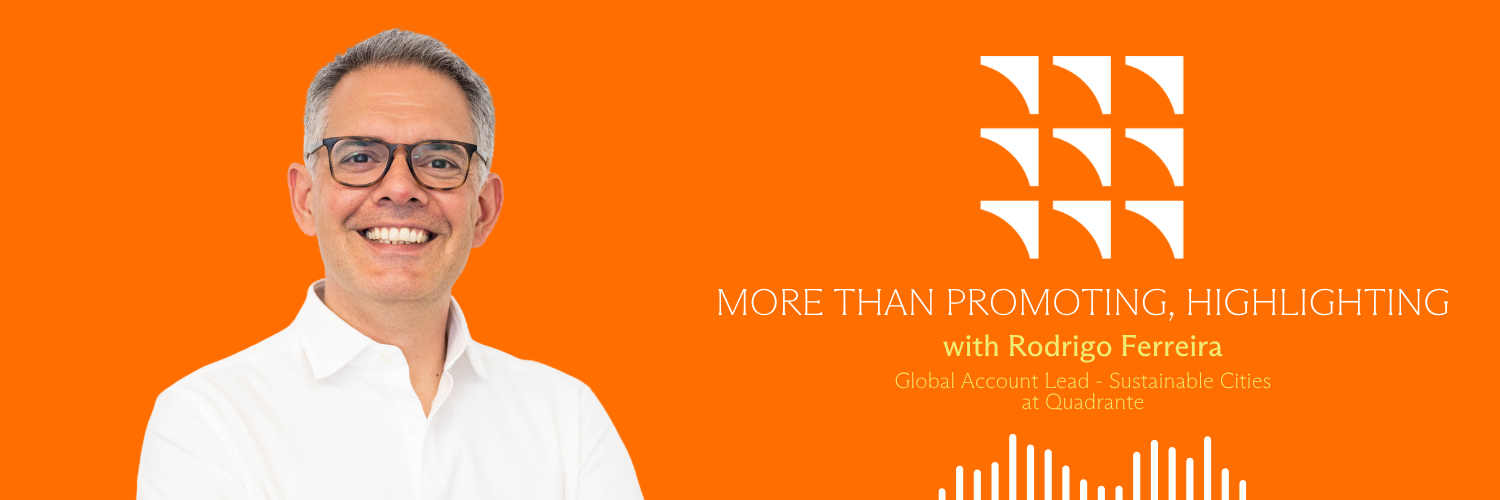
Quadrante: From environmental assessment to the financing of large-scale energy and infrastructure projects
The growing complexity of energy and infrastructure projects has increased the importance of environmental and social considerations in securing project approval and financing. In this context, Quadrante has established itself as a leading partner, supporting projects from initial concept through financing, construction and operation.
In this interview, Rodrigo Ferreira (Global Account Lead – Sustainable Cities at Quadrante), shares the company’s perspective on the role of environmental and social consultancy in the energy transition, the challenges facing African markets, and the opportunities associated with the development of sustainable projects.
What is the role of the Environment Division within the Quadrante Group and how is it currently organised – in terms of size, structure and geographical presence?
The Environment Division is one of Quadrante Group’s business units, forming part of the Sustainable Cities Business Sector, and operates across all the Group’s geographical areas and various engineering and architectural disciplines. We also work closely with the Energy and Mobility Business Sectors and benefit from the Group’s recognised technical expertise, reputation and international presence in Portugal and across the other markets where it operates.
This affiliation is crucial to our strategic positioning. We do not wish to be merely a consultancy that assesses a project once it has been conceived and designed. We want to be involved in the decisions that define the location, the concept, the alternatives, the costs and the timetable, combining environmental and social expertise with a practical understanding of the engineering, construction and financing of major infrastructure projects.
The division’s structure follows an international and multidisciplinary model, coordinating our own teams in Portugal, Africa and Latin America with local experts, consultants from various technical fields and partners in the countries where we operate. This model enables us to combine in-depth knowledge of national contexts, the capacity for international mobilisation and experience in projects subject to particularly demanding standards.
More than just a division focused on licensing, we are building an integrated, world-class platform for environmental and social consultancy. Our expertise covers impact assessment, Environmental and Social Due Diligence (ESDD), risk management, biodiversity, climate change, resettlement and livelihood restoration, stakeholder engagement, human rights, and environmental and social monitoring throughout the entire project lifecycle.
The division has grown very rapidly, driven by client recognition, Quadrante’s international expansion and a growing demand for increasingly specialised services. We combine senior leadership, operational teams with strong local knowledge and an international network of specialists. This structure gives us scale, without compromising on proximity, agility or our ability to devise solutions tailored to each project.
Our ambition is clear: to draw on Quadrante’s solid foundations and engineering DNA to develop an innovative, international Environmental Division capable of competing in the most demanding markets. Engineering provides us with pragmatism and the ability to deliver; the environmental and social aspects add risk anticipation, resilience, alternatives and long-term value.
What are the main areas of activity and services provided by the Environment Division? Is the work primarily focused on environmental licensing as set out in each country’s legislation, or does it also cover other aspects of environmental and social consultancy?
Environmental licensing, carried out in accordance with each country’s legal and institutional framework, remains a key pillar of our work. In Portugal, we oversee the entire licensing cycle and also provide industrial licensing and integrated environmental licensing services. We are involved in a number of nationwide projects and approach them responsibly. In the vast majority of cases, we join forces with other Business Units within the Group.
However, our work today extends far beyond this foundation. We support projects from site selection and planning through to financing, construction, operation and, where applicable, decommissioning. We work on impact assessment, biodiversity, climate change, contaminated land, spatial planning, environmental and social performance, GIS and digital solutions, in close collaboration with the Sustainability Business Unit.
We also have extensive expertise in projects receiving international funding. We carry out ESDD, often on behalf of the funders, as well as independent audits, the preparation of Environmental and Social Action Plans (ESAPs) – and the monitoring of their implementation during construction and operation. The social component includes stakeholder engagement, human rights, resettlement, livelihood restoration, working conditions and cultural heritage.
What sets us apart is our ability to translate these issues into practical decisions. We do not merely identify risks: we help to redesign solutions, prioritise actions and create the conditions for projects to be licensable, bankable and deliverable. Often, the best environmental measure is not to add a plan at the end; it is to change a location, an access route, a route alignment or a construction solution whilst that decision is still possible.
Within the broader context of the energy transition, what are the main types of renewable and low-carbon energy projects in which Quadrante has been involved, both in Portugal and in international markets?
In Portugal, our experience mainly covers solar photovoltaic and wind power projects, including power lines, substations and other grid connection infrastructure. We also have a growing presence in battery energy storage systems (BESS), biomethane and biogas plants, anaerobic digestion units and other projects related to energy recovery and decarbonisation. Our recent portfolio demonstrates a division that is attentive to developments in the energy transition and prepared to respond to new technologies and business models.
In international markets, particularly in Africa and Latin America, we work on large-scale solar, wind and hydroelectric projects, including dams, power transmission and distribution networks, ports and airports. In these contexts, the scale of the investments and the territorial and social complexity require teams capable of addressing biodiversity, land use, resettlement, livelihoods, community relations and funders’ requirements.
Our involvement can begin well before the licensing stage, with site selection, the analysis of alternatives and the identification of constraints, and continue through financing, construction and operation. We assess the energy system as a whole – generation units, access routes, transmission lines, substations and ancillary facilities – and seek to integrate environmental and social measures into the engineering design itself, rather than treating them as a separate element.
Through the close relationship between ALER and Quadrante, we have been following the company’s involvement in supporting various project finance operations led by Portuguese companies in Africa and Latin America, even outside the renewable energy niche. Which sectors have taken on the greatest significance in this type of work?
Energy and major infrastructure projects have taken centre stage – as evidenced by the success of ALER’s initiatives in Angola and Mozambique. In the energy sector, solar, wind and hydroelectric projects stand out, along with transmission and distribution networks, energy storage, hydrogen and other low-carbon technologies. These are sectors undergoing rapid transformation, in which environmental and social risks can directly influence the design, financing and timing of investment.
In infrastructure, we have supported road, rail, port and airport operations, as well as water, sanitation and waste management projects. These are structural investments, often with significant interaction with the local area and communities, and involving relevant risks in terms of biodiversity, land acquisition, resettlement, working conditions, health and safety, and climate resilience.
We also have experience in the mining, industrial, agro-industrial, oil and gas sectors, and in social infrastructure, including health and education. This diversity is important because it means we must avoid one-size-fits-all solutions: each sector has its own risks, stakeholders, decision-making processes and financial requirements.
Across all these sectors, our role is to help transform technically promising projects into projects that are bankable and feasible. We can support project developers in preparing for financing or act independently on behalf of lenders, through ESDD, risk assessment, ESAP definition and monitoring. Our approach brings together engineering, the environment, the client and the financiers, anticipating issues that could lead to delays, additional costs or a loss of trust. We are most effective when involved in investment strategy discussions – that is where we believe we can add the greatest value.
In this context, who are the Environment Division’s main clients: public bodies, private developers, financial institutions, international lenders or engineering and construction firms?
We work with all these types of clients, and this diversity is one of the Division’s strengths. Private developers and engineering and construction firms play a very significant role, particularly in major energy and infrastructure projects, where we provide support with licensing, impact assessments, preparation for financing and monitoring during implementation.
We also work with public bodies and national governments on key projects in transport, energy, water, sanitation, waste management and social infrastructure. In these assignments, we combine strategic studies and environmental and social assessments with institutional support and the preparation of projects to meet the requirements of funding bodies.
Financial institutions, commercial banks, export credit agencies and development finance institutions are also key clients. In such cases, we act independently on behalf of the financiers, carrying out ESDD, audits, the definition and monitoring of ESAPs, and environmental and social monitoring throughout construction and operation. At the same time, we are stepping up our commercial engagement with banks, development finance institutions, export credit agencies and other international financiers, seeking to understand their priorities in advance and build long-term relationships based on trust.
Understanding the different perspectives at the table gives us a real advantage. We understand the developer’s priorities, the engineering constraints, the concerns of the authorities and local communities, and the criteria of the financiers. This enables us to act as a technical bridge and help break the deadlock on decisions that might otherwise remain fragmented.
In addition to operating independently in the market, the Environment Division also provides support to the Quadrante Group’s engineering and architecture divisions. In what way does this multidisciplinary integration constitute an advantage, both in the preparation of tenders and in the execution of projects? Is this capability recognised by clients and by the markets in which the Group operates?
This integration is one of Quadrante’s key competitive advantages and a concrete expression of how we want to work. The Environment Division does not simply step in at a later stage to secure environmental approval and permitting for a project that has already been defined; it is involved from the very outset, identifying constraints, risks and opportunities that may influence the location, design, cost and timetable of the investment.
When preparing proposals, we are able to present a single, coherent vision, bringing together engineering, architecture, environmental, social and sustainability aspects. Rather than simply adding together disciplines that work in parallel and in isolation, we build a joint solution. This reduces interfaces, improves risk assessment and enables the client to have a team with clear responsibility for the overall outcome.
During implementation, direct contact between environmental and social specialists and the project teams enables mitigation measures to be incorporated into the design, alternatives to be tested and problems to be resolved before they reach the construction site or the funding process. In practice, this means less rework, faster decision-making, greater control over costs and deadlines, and more robust solutions.
This capability is recognised by clients, particularly on highly complex projects. The market values a team that understands the technical solution, the local context and international standards all at once. We are part of an engineering group that is respected both in Portugal and internationally, and we want to use that credibility to go further: not just to meet requirements, but to improve projects.
With regard to Portuguese-speaking African countries, do Mozambique and Angola continue to account for a significant proportion of the Environment Division’s portfolio? What developments have you observed in these markets, and which sectors currently offer the greatest potential?
Yes. Angola and Mozambique continue to account for a very significant proportion of our international portfolio and are markets where Quadrante has built up experience, relationships based on trust and institutional knowledge over many years. This foundation enables us to pursue new opportunities more swiftly, whilst also taking local specificities into account.
In Angola, we are seeing clear diversification. In addition to the traditional sectors (transport networks and electrification, road and rail infrastructure, water, sanitation and urban development), demand is growing in areas such as solar energy, biomass and hydrogen projects, desalination infrastructure and heavy industry, amongst others. Our recent portfolio includes dozens of solar projects, power lines, roads, bridges, railways and water supply systems, including ESDD and ESAP monitoring.
In Mozambique, we maintain a strong presence in energy, transport, ports, mining and major capital projects. The most interesting development has been the shift from licensing towards more specialised and ongoing services, such as management systems, construction supervision, biodiversity, resettlement, community engagement and monitoring of funders’ requirements. Based on our many years of on-the-ground experience, gas projects in northern Mozambique involve, in this context, various environmental and social strands of work.
In both countries, we see greater potential in the energy transition, associated networks, logistics corridors, water and sanitation, and projects funded by international institutions. The challenge – and also the opportunity – lies in combining local teams, knowledge of the territory and international methodologies, thereby creating robust solutions and technical capacity that remains within the markets themselves.
What are the main environmental and social challenges currently facing energy and infrastructure projects in African and Latin American markets?
The first challenge is to reconcile the scale and urgency of investments with complex territorial, social and institutional contexts. Land acquisition, physical or economic resettlement, restoration of livelihoods, community engagement and the management of local expectations can determine a project’s acceptance, timetable and, ultimately, its viability.
Biodiversity is another critical issue, particularly when projects traverse natural or critical habitats, protected areas or territories of high ecological value. The response cannot simply emerge at the end of the study: it is necessary to apply the mitigation hierarchy at an early stage, to scrutinise site selection and design, and to define technically credible restoration, compensation and monitoring measures.
Added to this are climate change, water scarcity, extreme events and infrastructure resilience, as well as working conditions, the health and safety of communities, human rights, cultural heritage and the conduct of security forces. These issues cut across environmental, social, engineering and management aspects and require teams capable of taking an integrated view of the project.
There is also often a distinction between being legally licensed and being ready for international financing. A project may comply with the national framework and yet still fall short of the Equator Principles IV, the IFC Performance Standards or other requirements set by financiers, including best practice.
The key is to anticipate these risks and build decision-making processes based on data and experience. The earlier these risks are addressed in the planning and technical design stages, the greater the chance of avoiding conflicts, delays and additional costs. This is where we aim to think outside the box: using data, engineering and local knowledge to find solutions before problems become commitments that are difficult to change.
How significant are the requirements of international financial institutions – notably the Equator Principles and the IFC Performance Standards – in the preparation and implementation of these projects today? To what extent does the national legal framework differ from these standards?
They are of central importance today. In projects subject to international financing, the Equator Principles IV and the IFC Performance Standards are not merely best practices: they influence the structuring of the financing, the conditions precedent to disbursement and the obligations the project will have to fulfil during construction and operation. In many cases, the ability to demonstrate robust environmental and social management is just as relevant to bankability as the technical or financial solution.
The difference compared with the national legal framework varies from country to country. In some markets, there is significant alignment; in others, legislation focuses primarily on licensing and the approval of the impact assessment. International standards cover the entire life cycle and delve into issues such as cumulative impacts, critical habitats, human rights, labour conditions, grievance mechanisms, land acquisition and the restoration of livelihoods.
In Portugal, we have maintained an open channel of dialogue with the Portuguese Environment Agency and with other public bodies involved in the licensing processes, as well as private organisations. These interactions are important for discussing the adoption – albeit selective and tailored to the national context – of international best practices that can enhance the quality of environmental and social assessment, licensing and monitoring. It is not a question of importing models uncritically, but of choosing what adds value and adapting these methodologies to the Portuguese context.
In practice, compliance with national legislation remains mandatory, but it may not be sufficient to secure international funding. It is necessary to identify the differences between frameworks, translate them into an Environmental and Social Action Plan (ESAP) with responsibilities, deadlines and indicators, and monitor its implementation. It is precisely in this bridge between the national framework, engineering and the expectations of funders that Quadrante’s international experience creates the most value.
Does innovation in Quadrante’s Environment Division involve merely the adoption of GIS and digital tools, or does it also involve the development of new skills? How important is it to identify and train young graduates in the markets in which the company operates, providing them with exposure to international methodologies and standards that are still relatively uncommon in the Portuguese market?
Innovation is not limited to Geographic Information Systems, remote sensing, digital platforms or monitoring systems, although these tools are already transforming the way we collect, cross-reference and communicate information. Quadrante has been developing its own solutions for geospatial analysis, data collection, information processing and environmental and social monitoring, enabling faster and more transparent decision-making.
But innovation is, above all, about building skills and new ways of working. It means combining environmental and social issues with engineering, international finance, climate change, human rights, resettlement, biodiversity and data analysis. Technology only has a real impact when teams are able to interpret the results, challenge assumptions and translate them into project decisions.
For this reason, identifying and training young graduates is a key strategic priority. We seek to recruit professionals from the markets in which we operate and provide them with real-world experience of complex projects, international teams and frameworks such as the IFC Performance Standards, the Equator Principles and the World Bank’s environmental and social framework. Learning takes place on the ground – through studies, audits, interaction with communities and monitoring – rather than solely through theoretical training.
This model combines senior expertise with youthful energy, local knowledge with global methodologies. Through mentoring and knowledge transfer during project implementation, we aim to build progressively self-reliant teams and sustainable technical capacity in the countries where we work. This is also a form of innovation: leaving a market better prepared than the one we found. Our teams are made up of highly motivated staff, with impressive learning curves, a critical mindset and a desire to take part in projects that think outside the box: challenging, demanding and capable of accelerating their professional development.
In Portugal, too, there is considerable scope to strengthen this approach. Some of these methodologies are still rarely used in everyday practice, particularly when applied in an integrated manner throughout the life cycle. We want to train a new generation of consultants capable of working simultaneously within the national framework, in engineering and in line with international requirements – a generation with technical rigour, curiosity and the courage to propose different solutions.
Looking ahead, what is Quadrante’s Environment Division’s medium- and long-term strategy? Which markets, areas of expertise and service lines will be prioritised for its growth?
Our ambition is to build, within Quadrante, an international environmental and social consultancy platform that is particularly strong in project finance. We want to combine the strength of a respected engineering group, the international experience of its teams, local knowledge and digital innovation to compete in the most demanding markets and support projects with a real impact.
Geographically, we will consolidate our position in Portugal and Africa, where we already have teams, experience and long-term relationships, and accelerate growth in Latin America, prioritising Brazil, Mexico, Chile and Peru, as well as other markets where the Group has a presence and major projects – such as in the US. In Mexico and Brazil, we are already building teams with a clear focus on project finance and forging strong local partnerships with small and medium-sized companies that are highly specialised and possess exceptional technical expertise. This model allows us to combine a local presence, regulatory knowledge and international capability without sacrificing agility.
We do not want to grow by offering a generic licensing service – that would leave us in the middle of the pack. Our priority areas will be high-value-added services linked to financing and implementation: ESDD, impact assessments aligned with lenders’ requirements, ESAP and its monitoring, independent advisory services for financiers, IESC (Independent Environmental and Social Consultant), resettlement and livelihood restoration, stakeholder engagement and human rights.
We will also strengthen our expertise in biodiversity and critical habitats, net loss and net gain, climate change and resilience, resource efficiency and the energy transition. At the same time, we will continue to invest in GIS, remote sensing, data analytics and digital tools that make analyses faster, more consistent and more useful for decision-making.
This growth must be accompanied by a genuine capacity for delivery. We will bring together international experts with local teams, invest in training young consultants, develop common methodologies and strengthen quality control. We want to grow quickly, but without compromising on rigour, proximity, agility or trust.
In short, we want to move away from a model based on isolated services towards an integrated offering that supports projects from the initial idea through to financing, construction and operation. Our ambition is to think differently, challenge existing solutions and open up new markets, always building on a very solid foundation: Quadrante’s experience, reputation and engineering culture. Our pipeline already includes several mega-projects led by European companies, particularly Portuguese ones, in Africa and Latin America, which confirms the relevance of this strategy and the market’s growing confidence in Quadrante’s capabilities.