

Mozambique in numbers: energy access, renewables and investment
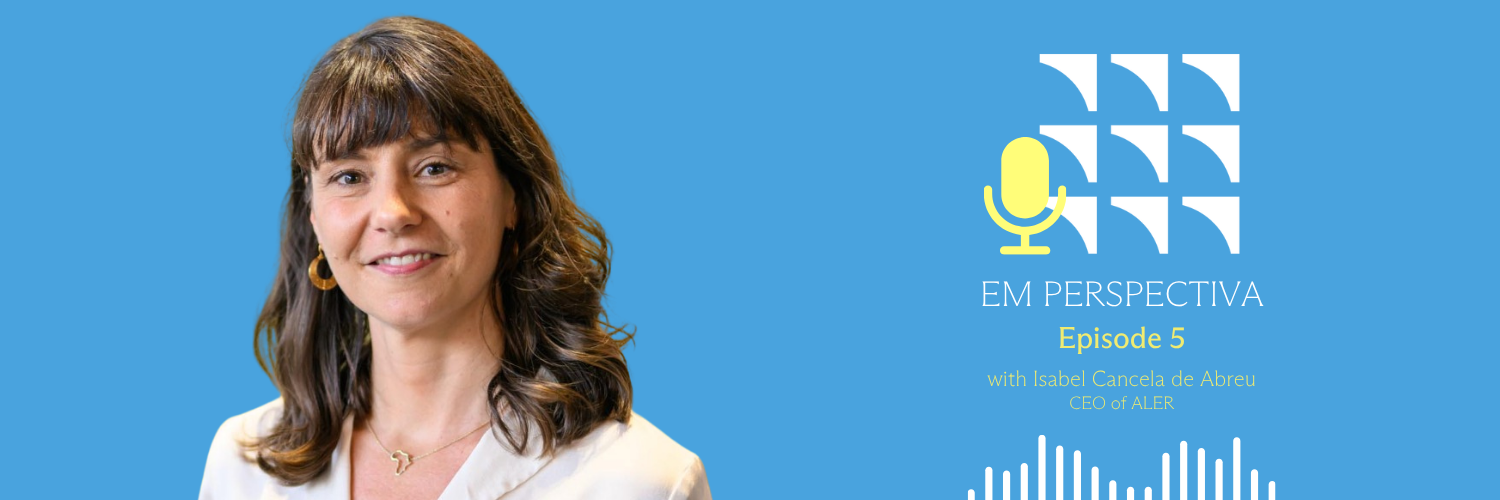
“Em Perspectiva” is ALER’s new opinion and analysis series, where the latest developments, trends, and debates shaping the energy sector in Portuguese-speaking countries are examined.
In this edition, Isabel Cancela de Abreu, ALER’s Executive Director, analyses the key findings of the “Briefing: Renewables in Mozambique”, launched during RENMOZ 2026, and reflects on what these figures reveal about the country’s energy transition.
The discussion covers progress in electricity access, projected growth in installed capacity, the role of renewable energy, off-grid solutions, financing challenges and the investment opportunities presented during RENMOZ.
The conversation that inspired this article is also available as a podcast on Spotify.
Isabel, RENMOZ 2026 brought together more than 600 participants and was marked by several announcements, agreements and investment opportunities. After these two days of conference, what is the main message you take away from this edition?
I think the main message is that Mozambique is entering a new phase of its energy transition.
For many years, discussions focused mainly on the country’s enormous energy potential. The focus then shifted to developing the regulatory framework and, more recently, to the Energy Transition Strategy.
At this edition of RENMOZ, I sensed a very clear shift. The conversation moved away from potential and towards implementation: the projects that are ready to move forward, how they will be financed and the mechanisms for their procurement.
This is precisely what enabled the announcement of new public tenders, the signing of financing agreements and the presentation of strategic programmes for the years ahead.
Taken together, these developments show a sector that is becoming more mature and increasingly focused on turning potential into concrete results, particularly as the goal of universal energy access by 2030 approaches and as the conditions for Mozambique to position itself as a future regional energy hub continue to strengthen.
It was also during RENMOZ that we launched the new edition of the Renewables in Mozambique Summary Report, a publication that helps us understand where the country stands today and how these policies are beginning to translate into tangible results.
Looking at the data from the Briefing, which indicator best reflects the current state of the sector?
There are many important figures, but I would probably start with the electrification rate.
In 2025, Mozambique reached 66.4% electricity access, meaning that in just six years the country has almost doubled its electrification rate and consistently outperformed projections.
This progress is reflected in a very concrete figure: around 436,000 new grid connections were made in 2025 alone.
This is particularly significant because the country needs to deliver approximately 440,000 new connections per year to achieve universal access by 2030. In other words, Mozambique is already very close to the pace required to meet that target.
At the same time, the data show that progress remains uneven across the country. Provinces such as Maputo have electrification rates close to 97%, while others remain below 40%.
The next challenge is therefore not only to increase electricity access, but also to ensure that access is distributed more evenly across the country, including through off-grid solutions in rural areas.
Yet electricity access is only part of the story. The Briefing shows there is a much greater opportunity to increase electricity use across the economy.
Exactly. When we analyse final energy consumption, we see that electricity accounts for only 13% of total final energy consumption.
This reveals enormous potential to electrify economic activities and replace conventional fuels, whether in transport through electric mobility, in clean cooking through electric appliances, or in agricultural, industrial and commercial equipment currently powered by diesel generators.
Mozambique’s Energy Transition Strategy foresees electricity accounting for 44% of final energy consumption by 2050. This is fully aligned with the recent target announced by the COP31 Presidency to increase electricity’s share of final energy consumption to 35% by 2035.
The real challenge is therefore no longer only about bringing electricity to people.
It is about using electricity to diversify and modernise the energy mix, accelerate economic development, support green industrialisation and promote productive uses of energy that generate business opportunities, income and employment throughout the country.
Another striking figure is the projected growth in installed capacity. What do these numbers tell us?
Mozambique currently has around 3,000 MW of installed capacity, but projections indicate this could reach approximately 9,500 MW by 2032.
That means more than tripling today’s capacity within a relatively short period.
What is even more interesting than the growth itself is how that growth is expected to happen.
Hydropower will continue to represent the largest share of new capacity, with around 2,300 MW added. Solar energy is expected to add roughly 1,000 MW, while wind energy, which currently has almost no presence in Mozambique’s electricity system, is projected to reach about 340 MW.
These figures show that Mozambique is not only expanding generation capacity. It is also building a more diversified electricity system capable of integrating increasing shares of renewable energy.
And this is also reflected in the growing role of renewables within the electricity system.
Absolutely. Today, renewable energy already accounts for around 65% of electricity generation serving domestic demand, and projections point to around 80% by 2032.
This is particularly significant because very few countries manage to simultaneously expand electricity access rapidly, triple installed capacity and maintain an electricity system strongly based on renewable energy sources.
Mozambique’s renewable energy potential is widely recognised. The real challenge now is to transform that potential into projects, and those projects into economic and social development.
The data from the Briefing show that this process is already underway.
Mozambique is putting in place the conditions to meet growing domestic demand, support industrialisation and, at the same time, strengthen its role as a regional energy supplier.
But the energy transition is not only about centralised electricity generation.
Exactly, and that is one of the key messages from this Briefing.
The energy transition is also about off-grid electrification and access to clean cooking solutions, both of which are essential to improve the quality of life of millions of Mozambicans, particularly in rural areas.
Mozambique currently has 113 mini-grids representing around 11.7 MW of installed capacity. The sector is expected to receive a new boost through a model that positions FUNAE as a facilitator and fund manager while implementation increasingly shifts to the private sector through competitive tenders.
Solar home systems are another essential component of this strategy. Around 860,000 systems have already been sold, providing electricity to communities still beyond the reach of the national grid. However, market growth has recently slowed, highlighting its continued dependence on support programmes and a more favourable fiscal framework.
In the clean cooking sector, approximately 939,000 improved cookstoves have already been distributed, but the challenge remains significant. In 2023, only around 17% of the population had access to clean cooking solutions. Accelerating this market will depend on LPG adoption, supportive fiscal measures and innovative financing mechanisms such as carbon markets.
Ultimately, the energy transition cannot be measured solely in megawatts installed. It must be measured by the impact energy has on people’s lives: improving living conditions, creating economic opportunities, generating income and creating jobs.
That is the true energy for development that we want to promote.
Financing remains a recurring theme across the sector. Is it still the main challenge?
In energy foruns, we often say that financing exists, what is lacking are bankable projects.
One of the most important outcomes of RENMOZ was precisely demonstrating that Mozambique now has an increasingly structured, diversified and bankable pipeline of projects.
During the RENMOZ Business Sessions, EDM, FUNAE, ARENE, HCB and GMNK presented projects in generation, transmission and off-grid electrification representing several billions of dollars in investment opportunities.
Having these projects identified, structured and presented to the market is a crucial step towards attracting financing.
This interest was clearly visible during the conference. Approximately one quarter of participants represented financial institutions or development partners.
More importantly, this interest resulted in concrete outcomes, including the signing of the Subsidiary Agreement between Enabel and FUNAE and the ElectrFI financing agreement with Source Energia.
RENMOZ therefore demonstrated that financing is available when credible and well-prepared projects exist.
Looking again at the Briefing, what does it tell us about the path Mozambique must follow to mobilise the investment required to implement these projects?
The main message is that the financial challenge is enormous.
The Energy Transition Strategy estimates investment needs of around USD 18.6 billion by 2030 and more than USD 80 billion by 2050. This clearly shows that the energy transition will only be possible through a combination of different financing sources.
Support from development partners for renewable energy has increased in recent years, but these flows are expected to decline as current funding cycles come to an end. At the same time, public investment capacity remains constrained by fiscal limitations and high levels of public debt.
This means the role of the private sector will become increasingly important.
Between 2013 and 2024, around 20% of the USD 755 million invested in renewable energy came from private capital. This is an encouraging sign, but still insufficient considering future needs.
The way forward is to use public funding and international cooperation to reduce project risks and mobilise greater levels of private investment, including through local-currency financing.
The first dedicated credit lines have already delivered encouraging results. The next step will be to expand these mechanisms to additional financial institutions and market segments, including self-consumption, while complementing them with tools such as microfinance and crowdfunding.
In essence, public financing will remain essential, but increasingly as a catalyst for private investment.
Finally, when you look at the sector today, what gives you the greatest reason for optimism?
What makes me most optimistic is seeing all the pieces of the energy transition finally moving forward at the same time.
Through RENMOZ 2026, we were able to focus the discussion on concrete projects, launched tenders and mobilised financing.
At the same time, we have demonstrated the existence of a clear strategic vision, a regulatory framework that continues to evolve and growing participation from both the private sector and development partners.
Of course, significant challenges remain, particularly in mobilising financing and ensuring projects are implemented at the necessary pace.
But these challenges are very different from those we faced five or ten years ago.
The results achieved so far, announced during RENMOZ and reflected in the indicators presented in the “Briefing: Renewables in Mozambique 2025”, show that we can look to the future with hope and confidence in the ability of both the public and private sectors to deliver Mozambique’s energy transition.