
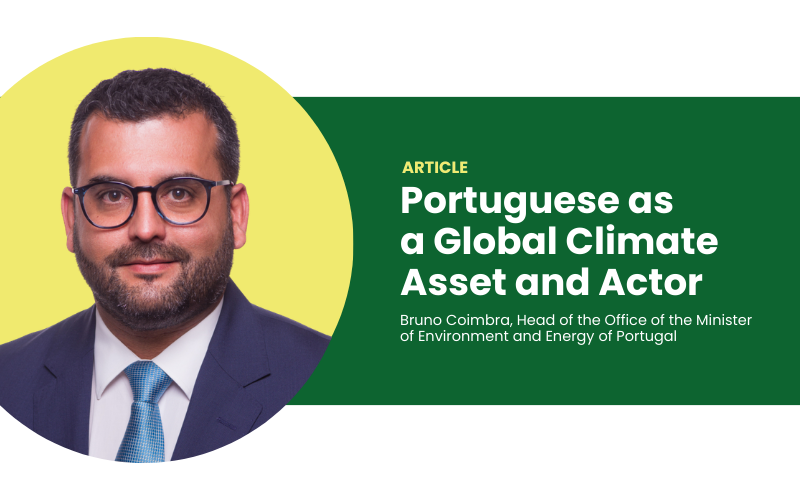
Portuguese as a global climate asset and actor
COP30 – held on the doorstep of the Amazon – was a strategic opportunity for Portuguese-speaking countries to assert themselves in the global reflection, discussion, and negotiation on climate and energy. For the first time, a Conference of the Parties took place in a Community of Portuguese Language Countries (CPLP) member state, shifting the center of climate diplomacy to a geographic and cultural space of unquestionable legitimacy in relation to the challenges facing the planet.
More than simply being present, the CPLP – with Portugal leading this process – was able to make a joint voice heard, particularly on the issues that most affect its members: adaptation, financing, a just transition, and access to energy. A clear example of this leadership is the Lusophone Transparency Fund, an initiative announced at COP30 through which Portugal will make €1.5 million available – starting on 1st January 2026, and over the following five years – to strengthen transparency, inventories, and climate finance policies in Lusophone countries.
Accompanied by technical and diplomatic coordination, the diversity of CPLP countries – with distinct economies and vulnerabilities that nonetheless face similar constraints in terms of financing and institutional capacity – proved to be a political asset. The Portugal Pavilion, which hosted several CPLP events among others, became a meeting point for the Lusophone world, culture, science, and business. With events dedicated to structural themes – from carbon markets to coastal resilience, as well as electrification in Africa and climate governance – Portugal acted as host and facilitator of Lusophone dialogue on a global scale.
Portugal’s experience in climate planning and financing offers tools that can be shared and adapted. The country has consolidated an integrated approach combining strategic planning, regulation, financial instruments, and climate action. The National Energy and Climate Plan 2030 (PNEC 2030), the Basic Climate Law, the Portuguese Climate Agency, and the forthcoming Roadmap to Climate Neutrality 2045 demonstrate Portugal’s commitment to structuring predictable and credible policies – essential factors for attracting investment and strengthening the confidence of partners and markets. This institutional robustness represents an advantage in cooperation efforts and in the broader positioning of CPLP countries which, although they have plans in place, often face challenges in mobilizing financing due to limited technical integration or institutional capacity.
Financial innovation is another area where Portugal leads by example. The debt-swap mechanism with Cape Verde – converting bilateral debt into direct investment in renewable energy, resilience, and biodiversity, while fostering cooperation and local community development and creating synergies between the two countries – has become a reference within the Lusophone community. Portugal is currently preparing a similar mechanism for São Tomé and Príncipe, demonstrating the scalability of such solutions and the opportunity they represent, particularly when they combine solidarity, vulnerability reduction, and local economic dynamization. These instruments show that climate cooperation does not have to be merely declaratory; it can deliver tangible impact on the ground.
Likewise, Portugal’s role as a promoter of energy efficiency and sustainable electrification – including in the regulatory context – reinforces the idea that the energy transition should be seen not only as a technical challenge but also as an exercise in social justice. Portugal’s focus on efficiency, buildings, mobility, and smart regulation shows that the energy transition will only be just if it is also efficient and accessible – a reality that applies even more profoundly to CPLP countries.
In a challenging environment such as any global negotiation stage – where interests, approaches, and visions may diverge – COP30 succeeded in approving a package of decisions, preserving essential consensus and ensuring concrete progress for global climate action, including for CPLP territories. Portugal, true to its history and reputation – and with Minister of Environment and Energy Maria da Graça Carvalho as a key asset in the Belém chessboard – was among the countries that worked to unlock agreements without compromising ambition.
Bruno Coimbra
Head of the Office of the Minister of Environment and Energy of Portugal
This article was originally published in the 4th edition of Energy and Climate in the CPLP Magazine. Access here.