

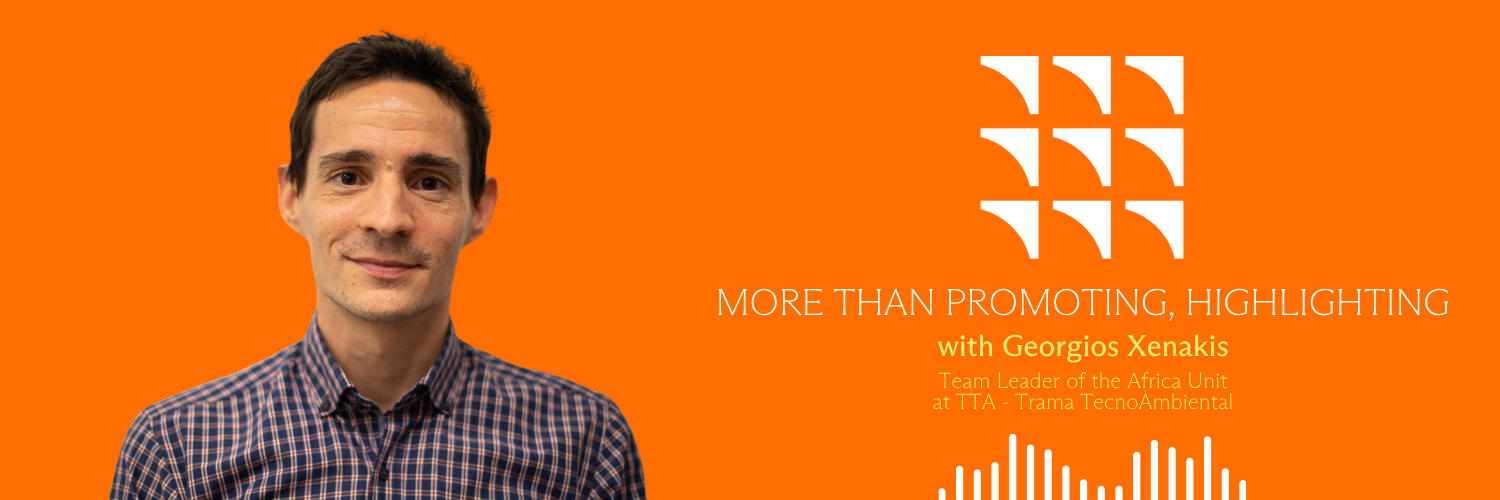
Energy Access in Africa: the role of decentralized solutions according to TTA
Since its founding in 1986, Trama TecnoAmbiental (TTA) has been working to promote access to energy services through a holistic model, based on renewable energy and decentralized stand-alone solutions, with the aim of increasing community resilience. With four decades of accumulated experience and projects in more than 100 countries, TTA has established itself as a benchmark in the energy access sector.
In this interview, Georgios Xenakis, Team Leader of TTA’s Africa Unit, shares the lessons learned along this journey, the company’s vision on the role of decentralized solutions in energy access, and its recent work in countries such as Guinea-Bissau and Mozambique.
TTA is celebrating 40 years of activity. What does this milestone represent, and how has the organization evolved over these four decades?
Forty years of fieldwork represent, above all, an extraordinary accumulation of practical knowledge. TTA was founded on the belief that access to energy is a fundamental right, and this purpose has guided us from the beginning, now aligned with the United Nations SDG7. Over time, we have evolved from early pilot experiences with solar photovoltaic systems to increasingly complex projects.
What sets us apart is our holistic and integrated approach: we do not limit ourselves to engineering. We work across the entire value chain, from national planning and regulatory development to feasibility studies, detailed engineering, construction supervision, commissioning, and operation and maintenance – always incorporating economic, social, and environmental dimensions. We believe this holistic vision is what ensures that projects are sustainable and generate real impact in communities.
Our track record in more than 100 countries – across Latin America, Africa, Oceania, Europe, and Asia – has enabled us to develop a deep understanding of the diversity of contexts in which we operate. Every project is different, every community has its own specific needs, and that is the richness of the work we do.
In your view, what is the central role of decentralized renewable energy in enabling energy access in Africa?
Access to energy is a catalyst for development. When a community has access to reliable electricity, everything changes: children can study at night, health centers can store vaccines, businesses can grow, and water can be safely pumped and treated. It is not just a technical issue – it is a matter of dignity and opportunity. Moreover, ensuring access to energy also strengthens climate resilience, which is crucial in the current context.
In Africa, where millions of people still live without access to electricity, decentralized solutions are often the only viable response in the short to medium term. Extending the national grid requires significant investments, which are not economically justified for remote communities with low population density. Solar mini-grids and stand-alone solar systems offer a faster, more affordable, and, importantly, more resilient alternative.
Our conviction, reinforced by four decades of experience, is that universal electrification in Africa will only be achieved by combining grid expansion with these decentralized solutions for the most remote communities. It is not a matter of choosing one approach over the other – it is about having the intelligence to apply the right solution in each context.
At present, the debate around imported fuels and geopolitical impacts has gained renewed relevance. How do you see this context in light of Africa’s energy transition?
Dependence on imported fuels is a structural vulnerability for many African countries. This dependence exposes economies to external shocks: fluctuations in oil prices, supply crises, and geopolitical tensions. The impact of current conflicts, for example, has already been felt particularly strongly in countries most dependent on energy imports, with sharp cost increases and supply disruptions.
This context clearly reinforces the case for local renewable energy. A decentralized solar system with battery storage is not subject to international supply crises. Solar energy is local, reliable, and renewable. Investing in local clean energy is not only an environmental choice – it is a choice for energy sovereignty and economic resilience.
For rural communities and public institutions such as hospitals and schools, this reality is even more evident. A diesel generator entails ongoing and uncertain operating costs that could otherwise be used for health and education services. A solar system involves upfront costs that, once amortized, provide decades of clean and predictable energy. For this reason, the installation of solar photovoltaic systems in hospitals, industries, and other diesel-dependent users should be a priority, in order to enhance operational resilience and free up resources for other investments (for example, allowing hospitals to redirect spending from diesel to strengthening healthcare services).
Can you share some concrete examples of TTA’s projects in Africa?
TTA has worked in most African countries, including Portuguese-speaking countries such as Guinea-Bissau and Mozambique.
In Guinea-Bissau, our projects began in 2013 with technical support for the creation of the country’s first mini-grid, in Bambadinca. We subsequently carried out several studies for decentralized solar systems in other regions of the country, including Cacheu, Gabu, Oio, and Bafatá. At present, we are working under the SESAP project, funded by the World Bank, on the electrification of health centers with stand-alone photovoltaic systems across all regions of the country.
In Mozambique, our work began in 2014 for the European Union Delegation and has included several planning studies and the design of decentralized solutions. Currently, we are working more specifically with our partners on productive uses of energy (PUE), under an ENABEL project, to analyze the benefits these can bring to the economic viability of mini-grids and to greater private sector participation. In this context, our colleague Alfredo Pais will once again participate in the next edition of RENMOZ and the Mozambique–EU Business Forum, events we follow with great interest to share our experience, learn about the latest initiatives in the country, and strengthen ties with local and international partners.
TTA is also co-organizer of the S-@ccess Conference, dedicated to solar technologies and mini-grids for energy access. What is your assessment of previous editions, and what can we expect from the next edition, scheduled for September 2027?
In our vision of becoming a reference organization that generates impact for the sector, S-@ccess is, for us, much more than a conference. It is a meeting space for professionals working in the field – engineers, consultants, financiers, academics, policymakers – with the concrete objective of sharing practical experiences and learning from one another.
The 2026 edition, held this month, confirmed the existence of a global community of stakeholders and practitioners in the decentralized energy sector who value this type of exchange. It also showed particular interest in the intersection between energy access and sectors such as health, education, and productive uses, as well as in issues related to the resilience of imported fuels in the current geopolitical context. In this edition, we were also pleased to welcome several Mozambican institutions, such as ARENE, FUNAE, and Eduardo Mondlane University.
This is why we can already announce the continuation of this initiative, with the next edition planned for September 2027. We want the conference to increasingly serve as a catalyst for change: not only a space for knowledge sharing, but also a driver of collaboration and concrete projects.
What message would you like to leave to the readers of the ALER Newsletter regarding the role of decentralized renewable energy in Africa’s energy future?
The message is simple, but urgent: decentralized renewable energy is not a second-tier solution for those without access. It is a forward-looking solution that combines economic viability, resilience, social impact, and environmental sustainability.
Forty years of TTA’s work around the world have taught us that technology is not the main barrier – solar systems work. What is needed is political will, adequate financing, and an approach that places communities at the center of decision-making.