

Public policies, projects, financing and cooperation
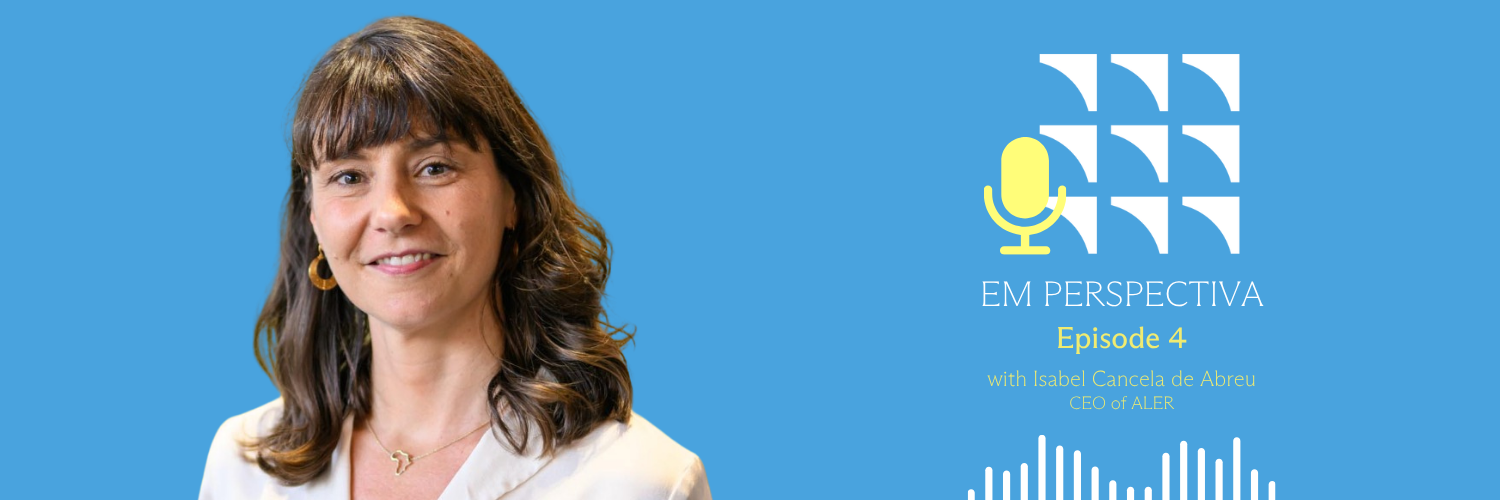
“Em Perspectiva” is ALER’s new opinion and analysis series, where the latest developments, trends, and debates shaping the energy sector in Portuguese-speaking countries are examined.
In this edition, Isabel Cancela de Abreu (CEO of ALER) looks at how energy transitions in Portuguese‑speaking countries are moving from strategy to implementation.
She discusses the strengthening of public policies, with the validation of Guinea‑Bissau’s National Energy Policy, projects in Mozambique and Angola, the mobilisation of financing and the growing role of regional cooperation in consolidating the energy sector. This is an integrated view of a sector that is gaining maturity by aligning strategic vision, execution and tangible impact.
The conversation that gave rise to this article is also available as a podcast on Spotify.
Isabel, this month we are faced with very diverse news — ranging from public policies to solar projects, financing and memoranda of understanding. If you had to summarise everything in one key idea, what would you say is the common thread?
The selection of news for the newsletter follows an editorial criterion, and this month the message is very clear: energy transitions in Portuguese‑speaking countries are already materialising on the ground.
We see this through the combination of three elements to which ALER has been contributing, by supporting both the public and the private sectors. On the one hand, the strengthening of public policy instruments, as in the case of Guinea‑Bissau’s National Energy Policy, which shows increasing clarity regarding objectives and priorities.
On the other hand, the materialisation of policy into concrete projects, such as solar projects in Mozambique and Angola. In other words, we are no longer talking only about strategies on paper.
And finally, the mobilisation of financing, which allows the transition, the projects and their respective impacts to materialise – such as the announcement of new support from the African Development Bank to São Tomé and Príncipe.
Added to this alignment is a fourth fundamental element: cooperation, which is one of ALER’s priorities. A good example is the memorandum of understanding recently signed between Angola and Brazil, resulting from the dialogue spaces created by ALER, such as the CPLP Energy and Climate Seminars.
Overall, these are signs of markets gaining maturity, where strategic vision, execution, financing and cooperation are starting to progress together.
You mentioned the strengthening of public policy instruments, which takes us directly to Guinea‑Bissau, where the National Energy Policy has been validated. Why is this step so important?
The drafting and validation of Guinea‑Bissau’s National Energy Policy is truly a structural step. As highlighted by the Director‑General of Energy in the editorial of our newsletter, this is the country’s first National Energy Policy, marking a profound shift in how the sector is planned and managed.
This policy clarifies the country’s strategic vision for energy: it defines priorities, sets medium‑ and long‑term targets and creates a coherent framework for articulating public decisions, investment and partnerships. In a sector historically characterised by fragmented interventions, this makes a significant difference.
ALER had the opportunity to provide technical support to the Ministry of Energy in drafting this policy, working very closely with multiple public and private entities and civil society. This participatory approach is one of the policy’s strengths and reinforces its legitimacy.
For us, this involvement reflects exactly the role we advocate for ALER: supporting the strengthening of public policies, improving energy sector governance and creating conditions for a structured energy transition in Portuguese‑speaking countries.
Of course, a National Energy Policy alone does not solve all problems, but it creates an essential framework of predictability and confidence for the State, investors and cooperation partners, allowing the sector to advance in a more structured way.
And how does the Energy Compact that Guinea‑Bissau is developing under Mission 300 fit into this process?
For ALER, these compacts are fundamental instruments because they make it possible to translate strategic priorities into concrete actions – reforms, flagship projects and investment pipelines – creating a clear basis for dialogue with financiers and partners. Essentially, they help move from vision to implementation, with the very concrete objective of accelerating universal access to energy by 2030.
A central aspect is that these compacts should not be developed in isolation. They are much stronger when designed in coordination with the national energy strategy or policy, ensuring alignment from the outset and a more efficient use of available resources.
There is also a very interesting dimension of regional cooperation. Mozambique and São Tomé and Príncipe have already presented their compacts, while Angola, Guinea‑Bissau and Cabo Verde are now in the final stages. Soon, all Portuguese‑speaking African countries will have defined compacts, opening up an excellent opportunity for experience‑sharing and joint learning, particularly during the implementation phase.
Let us now move on to projects. In Mozambique, the tender for the Dondo solar photovoltaic power plant was relaunched under PROLER. How do you interpret this announcement?
This relaunch sends a very positive signal: it shows continuity, commitment and strategic clarity in the country’s investment in renewable energy, as part of a broader strategy to mobilise private investment in the electricity sector.
The Dondo tender is part of PROLER, a structured programme launched in 2020 to promote the participation of independent power producers through public tenders, supported by the European Union via AFD, and which overall foresees around 120 MW in solar and wind projects.
These tenders are important because they combine transparency, competition and predictability, contributing to lower electricity prices and a greater opening of the electricity sector to private investment.
It is also important to look at PROLER as a whole. In addition to Dondo, there are the Manje and Chimbunila tenders, whose pre‑qualified bidders have already been announced, showing a pipeline logic, scale and continuity that are essential for market maturity.
And if in Mozambique we are talking about tenders, in Angola we are already talking about projects in operation. The Luau Solar Park is already supplying electricity. What does this project represent for Angola’s electricity sector?
The Luau Solar Park is an excellent example of a structural change in Angola’s electricity sector. It is not an isolated project, but a power plant embedded in a strategy that foresees around 60 solar projects by 2027, reflecting a clear commitment to diversifying the energy mix.
These investments already have a real impact: solar energy currently represents around 6% of electricity generation, demonstrating scale, planning and tangible results on the ground, and above all a consistent commitment to renewable energy.
At the same time, Angola is also undergoing reform of its electricity sector, including institutional reorganisation, the pursuit of greater financial sustainability and increased openness to private sector participation. This combination of operational projects and structural reforms is fundamental to consolidating a new reality for the sector.
Looking at these examples – in Guinea‑Bissau, Mozambique and Angola – can we say that we are moving from intentions to implementation?
Yes. What we are seeing is an increasingly clear combination of strategic vision, appropriate instruments, financing, projects and cooperation. It is this alignment that allows scale to be achieved, impact to be accelerated and energy transitions to become more resilient and sustainable.
ALER will continue to work precisely as a platform for cooperation, supporting Portuguese‑speaking countries in climbing what we like to call the energy transition ladder.